Luna AI
Democratizing access to scientific publishing
Luna AI is a proposed end-to-end generative AI UX research platform, built for academic labs and cost-constrained UX teams, combining a research repository with synthetic data generation to make large-scale, reproducible studies financially viable. As lead UX researcher and product designer, I led the 0 → 1 product definition, prototyping, and evaluation, establishing a research-grounded foundation for an MVP that augments researcher judgment rather than replacing it.

The Challenge:
Major UX research platforms charge $15 per pre-screened participant or thousands per seat, pricing out universities and small teams just as academic publishing standards are tightening replication and sample-size requirements. The result is a credibility gap where only well-funded institutions can meet the bar for peer-reviewed research. Synthetic data offered a path forward, but 77% of practitioners report concerns about bias, and academic reviewers remain skeptical of AI-generated data as a substitute for real human participants.
The Strategy:
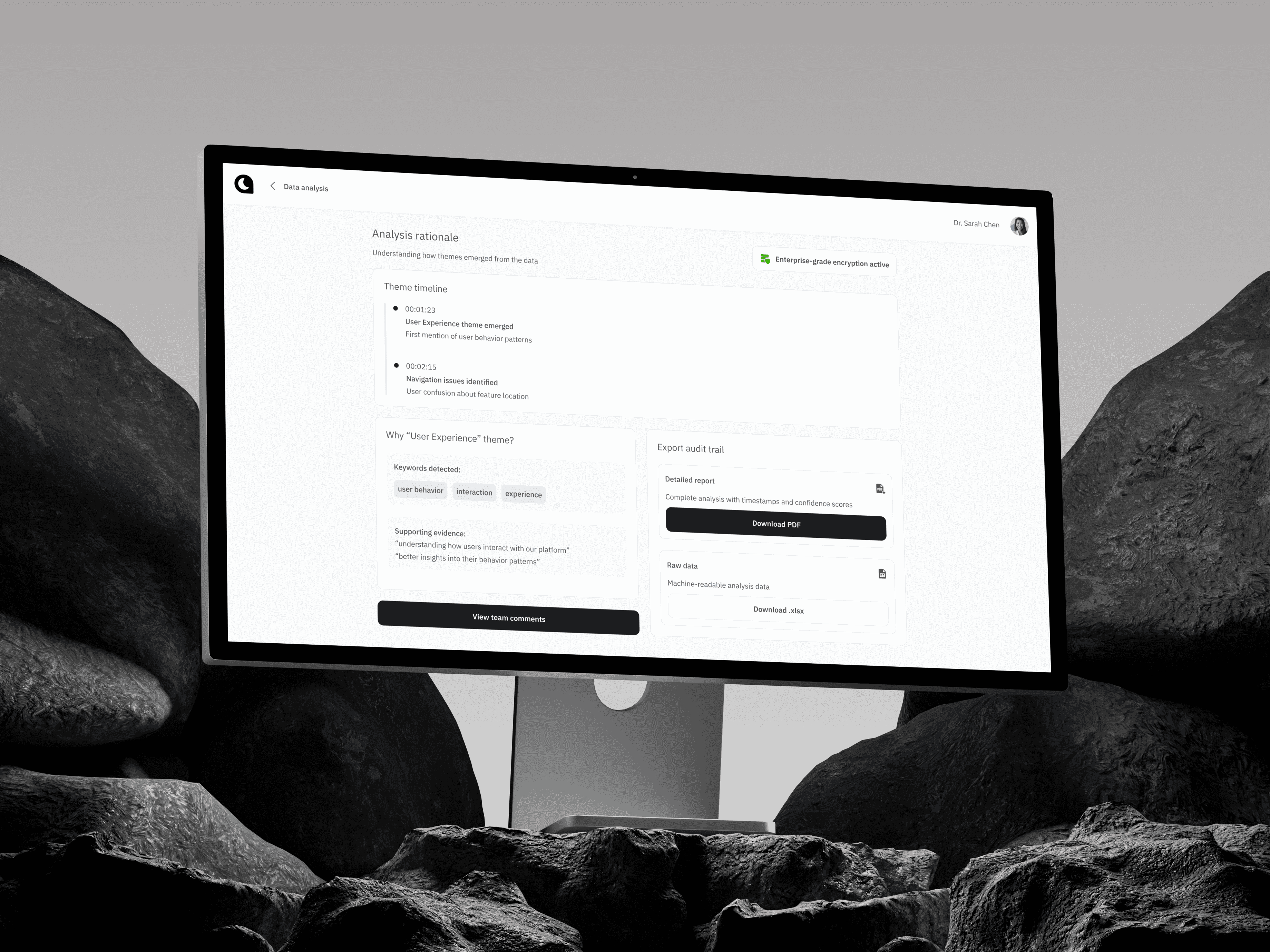
I conducted three in-depth stakeholder interviews spanning enterprise and academic perspectives, then triangulated the findings with Kano analysis, journey mapping, and a competitive landscape covering six direct and adjacent players including SyntheticUsers, Outset.ai, and Columbia Business School's digital twin panel. I scoped the MVP to three high-value flows — project creation, AI-assisted qualitative analysis, and synthetic data generation — prioritizing transparency features like explainability panels, audit trails, and credibility reports to address the trust gap. Across two moderated usability rounds with seven pre-screened participants, I translated findings into structured iterations on terminology, workflow continuity, and PII handling.
The Outcome:
Delivered a medium-high fidelity prototype across three core flows, with participants describing it as high-fidelity quality. Usability testing surfaced a prioritized roadmap of P1–P3 issues, directly informing iterations on information architecture, synthetic data transparency, and trust-signaling affordances. The project established Luna's strategic differentiation against enterprise-focused competitors by targeting academic researchers specifically, and is continuing into beta testing, contextual inquiries at BETA Hub, and investor and engineering conversations for MVP build.